Posts

Showing posts with the label Middle Elementary

Discussions on Fairness, Justice, and Equality in Middle Elementary

Image
Middle Elementary students have recently had many serious and heartfelt discussions about fairness, justice, and equality - what these concepts mean to us personally and in our society. In one of our recent discussions we had a demonstration of the difference between equality, in which everyone gets the same thing, and justice, in which everyone gets what he or she needs. We had a large curtain held up in front of three children of differing height. At first, when everyone was on the same level, only the tallest child could see over the curtain. Next, we gave everyone an object on which to stand, which raised each child to the same level so they could all see over. Three of the children made the following statements:      "Justice is a right for everyone. Everyone deserves it. Even if you've been bad, it's everywhere. Maybe it's in your heart or maybe in the deepest ocean or in the tallest mountain. You just have to look hard enough. ...

Mindfulness Practice in Middle Elementary

Image
Mindfulness is a practice we use in our classroom every day. We are using the Mindfulness curriculum designed by Mindful Schools and practiced across the country in many different school settings. The curriculum is structured to present a concept each week for intentional practice, which builds on concepts presented previously. Within this structure, mindfulness is defined as "paying attention to what is happening in the present moment." Mindfulness can help us pay attention to many things, and can help us calm down when we are angry, sad, frustrated, or in the midst of any difficult emotion.  This practice can also help us feel happy and help us focus on our tasks. The first lesson was having a mindful body, keeping still, and listening to the sounds in the environment. The second lesson was on mindfulness of breathing, paying attention to the rhythm of our breath, and finding an anchor place in our body for our breath to return to when our mind beg...

The Importance of Drama in Middle Elementary

Image
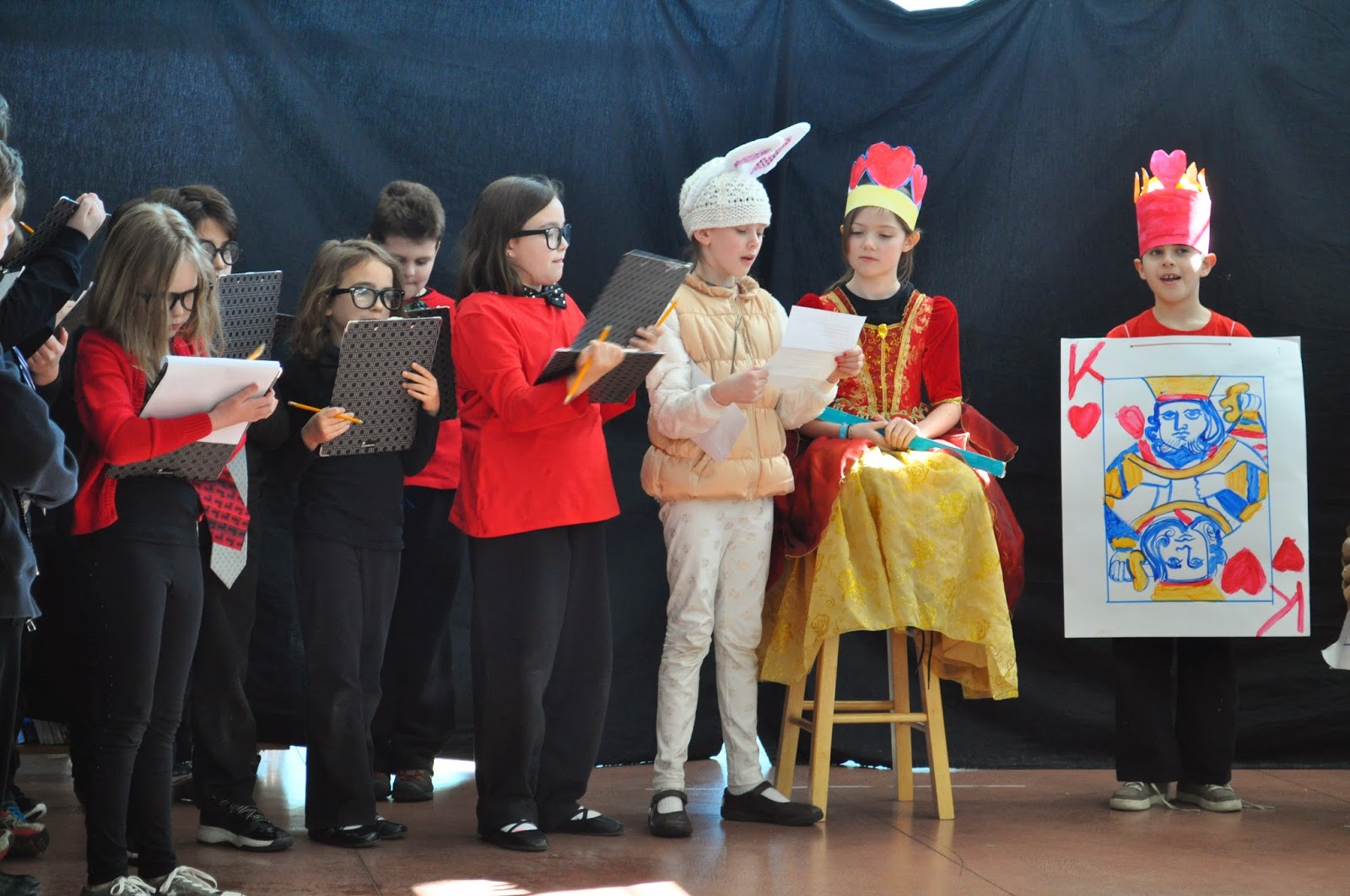
Our production of "Alice in Wonderland" was a delightful success.  The children were amazing in their ability to memorize their lines, entrances and exits, and blocking. They were unanimously supportive of each other, providing lines when someone forgot, reminding each other of where to be and when to be there, making sure that they had their props, and creating their costumes and props. Several who had asked for "little" parts expressed the desire for a larger part next time. This intense work helped them to bond with each other in a more empathic way. Numerous studies have demonstrated that students engaged in drama often experience improved reading comprehension, maintain better attendance records, and are generally more engaged in school. Drama contributes to a student's understanding of the work being performed and can help develop a better understanding of other works and of language and expression in general, including story recall, re...

Middle Elementary Studies the Early Renaissance

Image
During the first week back, the students organized their comments for inclusion in their progress reports.  Students were very clear about what they wanted to include in their self-assessments in all their subject areas. We also enjoyed having a student from St. Cecilia Academy working with our students that week as part of her junior year internship. She integrated beautifully with the students. They were excited to show her their work and just how smoothly they could run a classroom. Students examine representations of Roman architecture they viewed in paintings at the Frist.   Our first field trip of 2015 was "Sanctity Pictured" at The Frist. We prepared by discussing the impact of the spread of Christianity on the history of Europe following the fall of Rome, the use of paintings and illuminated manuscripts in dispersing information during a time when few people could read, the time and dedication necessary to write a book before the printing...

Bringing the Great Lessons to Life in Middle Elementary

Image
Cultural lessons began during the second week of school with the First Great Lesson, "The Birth of the Universe." This lesson directed our attention to the laws that govern the universe and make it possible for humans to investigate and make predictions about our world. The Second Great Lesson is "The Coming of Life," which allowed us to look at the great diversity of life.  "The Coming of Humans," the Third Great Lesson, focused our work on the human experiences of communal living, tool-making, shelter and communication needs, survival, and migration through the world. The work of the playground reflects these intense developments.  The lower playground, "the woods," is an ideal place for the children to do the work of planning, building, hunting and scavenging for materials, negotiating for desired objects, cooperating and collaborating within a group, communicating and solving differences, and developing systems of trade a...

Resource Pick: "Supporting the Elementary Child's Work at Home," by John Snyder

Image
It's clear that Montessori environments look much different from traditional classrooms. At Abintra, we hope to provide our community members with useful resources to help them get the most out of their child's Montessori experience. John Snyder Today's resource pick is the article "Supporting the Elementary Child's Work at Home" by Austin Montessorian John Snyder, former Chair of the AMI Elementary Alumni Association and member of the Montessori Leadership Collaborative. In this article, Snyder discusses how parents can contribute to their elementary student's Montessori experience outside of the classroom. As Snyder explains, "It's not worksheets. It's not assignments. It's practicing being an entrepreneurial learner in the context of the family." Snyder points out that "Basically, there needs to be a shift in thinking of the Montessori school as the place where the child is being educated to thinking of it as jus...

Middle Elementary Takes Their History Lessons Into the Woods

Image
Some of the most profound work that the children do happens during recess. Fort building has always been a social learning opportunity for Abintra's students.  For Middle Elementary, it recently took on added dimensions. Our cultural studies included the rise and fall of the Roman Empire.  We examined the many legacies that Rome has left to the modern world: word roots, mythology, the names of the planets, roads, aqueducts, indoor plumbing, public baths, and tile mosaics, to name just a few.  The Romans also left us with the idea of a representative democracy, emperors, senators, and consuls.  Additionally, public responsibility, slavery and the treatment of slaves, and the rights of women made an impact on our modern culture. Middle Elementary children took their history into the woods.  They began building a system of forts based on their understanding of Roman culture.  The forts included a store and headquarters where goods were ...

Research, Fractions, and More in Middle Elementary

Image
The hum of activity often turns into a buzz as children are thinking, planning, collaborating, researching, and working.  On any given day you can see individuals pursuing their interests, while pairs and small groups of students work together to complete research on common interests. Several students are currently working with fractions - equivalents, adding and subtracting like fractions, and multiplying fractions by a whole numbers.  Some students are learning to draw a floor plan of the classroom by sketching a rough draft, filling in the measurements, and drawing a scale model on graph paper. Individual and collaborative research is varied:  the bearded dragon, ancient China, the margay, poisonous snakes, Ireland, and building shelters like early humans.                          We are looking forward to warmer weather and being able to e...

Math in Middle Elementary

Image
Math in the Middle Elementary classroom is an exciting part of each day!  The students receive small group lessons and perform assigned follow-up work to reinforce the lesson.  Some students work individually and others choose to work with a friend.  They always have guide support and the ability to choose math work as their interest and aptitude dictates.      Our direct instruction is guided by "Everyday Mathematics" from the University of Chicago School of Mathematics Project using Montessori materials to illustrate the concepts. Follow-up work is based on the daily lesson and also reviews previously taught concepts.      Middle Elementary students are progressing from dependence on concrete materials to abstract thinking. Instruction and demonstrations use the concrete materials to illustrate the more abstract concepts.      Students enjoy a game of Multiplication ...

Middle Elementary: "The First Great Lesson"

Image
Science in Middle Elementary lends itself to the study of the world around us and the laws of the universe. The first Great Lesson, "The Formation of the Universe," introduced students to the states of matter and how varying degrees of heat and cold affect these states by performing simple experiments on readily available materials.  Did you know that without grasses there would be no human civilization beyond the hunter/gatherer?  Botany has included the study of grasses and grains, and extended that study to their importance to human agriculture and civilization. The study of the water cycle also contributes to knowledge about the effect of water, or its lack, on different biomes, and how that has affected the migration and settlement of animals and humans around the world. Biology has included the Time Line of Life and the interconnectedness of plant and animals, predator and prey. Students receive a lesson about spiders while observing one on our campus.  ...